Some of you have sent email or left comments asking for advice about how to name your company. The Name Inspector hopes you understand that it takes work to come up with good suggestions, and it’s not really sensible for him to do that work for free because his time is scarce and there are names to inspect and other things to attend to. So, as a response to these requests, The Name Inspector has decided to offer consulting services. If you’d like help with a naming project, ranging from a brief consultation to a full-on naming effort, please click on the “consulting” link at the top of the page to find out what to do.

While we’re on the subject of tooting one’s own horn, The Name Inspector would like to call everyone’s attention to an upcoming event that all independent (and independent-minded) businesspeople of the Pacific Northwest should attend: BizJam. It’s happening on June 9, and it’s organized by the good folks at Biznik, so it’s bound to be truly fun, interesting, and useful. The Name Inspector will be be speaking about “How to choose the perfect name for your business”. Head Bizniks Dan McComb and Lara Eve Feltin have done an impressive job of fostering an independent business community in Seattle and initiating and promoting great events. If you miss this one you’ll hear about it later and be sorry.

Tags: biznik, bizjam, seattlebizjam, consulting, name consulting, naming consulting, name consultant, naming consultant

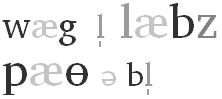
waggle-pathable-phonetic.jpg

Shelly Farnham and Peter Brown are the co-founders of Waggle Labs, a Seattle software and consulting company that specializes in social technology. Their new product, Pathable, lets participants in social events tag themselves with their interests and personal connections to find other similar participants. Shelly and Peter were kind enough to share a story about how they came up with these names. Here’s what they wrote (in the third person) about Waggle Labs:

Their goal was to have a name that reflected on the one side their creativity and sense of fun, and on the other side their extensive advanced prototyping and social science backgrounds. They brainstormed through a number of names with their friend Leo sitting in front of a whiteboard that had words like “social, innovative, fun, creative, smart, technology, internet, web” written on it.

Shelly and Peter had both been through the process of naming projects a number of times before, and had each developed a trust in their instinctive response to names (that “blink” reaction as described by Malcom Gladwell — he argues that through rapid cognitions we often reach instant conclusions that are “really powerful and really important and, occasionally, really good”). [link http://www.gladwell.com/blink/] The goal was to brainstorm through and develop a name they both instinctively liked. They both read a lot of science fiction, so one of the final contenders was General Galactic. Peter loved it, Shelly less so.

“It sounds like General Electric.” She recalls saying.

“But that’s great!” said Peter. “We can leverage residual name recognition.”

“Mmmm. But, General Electric! It is a very masculine name, brings to mind heavy machinery.”

Shelly was a part of an informal art group called Hive-Mind, referring to the emergent intelligence of collective organisms. [Link to Jordan's bee blog: http://hive-mind.com/bee/blog/ ] For her, bees and hives had a strong association with the power of the collective intelligence of the Internet. “What about something to with the Waggle Dance?” She thought the word waggle evoked a sense of lighthearted fun and the Waggle dance is a really amazing phenomenon:

From wikipedia:

Waggle dance is a term used in beekeeping and ethology for a particular figure-eight dance of the honeybee. By performing this dance, successful foragers can share with their hive mates information about the direction and distance to patches of flowers yielding nectar or pollen, or both, and to water sources.

Through innovative social technology they hoped to enhance people’s social experiences, providing direction to the online honey, so to speak. So Waggle Labs seemed like a great fit. After their brainstorming session they took a day to run both names by their friends: “What do you think, General Galactic or Waggle Labs?”. After twenty four hours of mulling over the issue, they decided to go with Waggle Labs. Much later, a few people pointed out the similarity between Waggle Labs and Google Labs — to which Shelly would shrug and smile and say “well I guess we can leverage residual name recognition.”

Despite the similarity to Google Labs, The Name Inspector is happy that Shelly and Peter decided to go with Waggle Labs. The great thing about this name is that it sounds really playful but has a serious and deeply interesting scientific association. The bee waggle dance is a fascinating case of animal communication that’s gotten a good deal of academic attention. The Name Inspector even had reason to learn about it during his linguistic training. Linguists like the waggle dance both because it shows how complex animal communication can be, and because it’s quite unlike human language, so it helps to show what makes the latter special. Among other things, human language has what Charles Hockett called duality of patterning-one system that defines discrete building blocks of sound (phonology), and a separate one that uses those building blocks to define meaningful units (lexicon) and their combinations (morphosyntax). That’s what allows us humans to have a such a big vocabulary and a limitless repertoire of messages. But The Name Inspector digresses.

Here’s what Shelly and Peter wrote about Pathable:

One of their projects is Pathable (still under development), an event-based social networking tool that explores the use of lightweight profiles with social tagging for matchmaking. They agreed upon the name with that same mutual, instinctive response. Shelly originally wanted to go with SpiderTap. The spider in the web is another metaphor for online social interactions that Shelly always liked. “You tap the strands you’ve spread through the web, see where there’s a wiggle, and move in that direction.” Peter did not like spiders however. They then thought through a few more names around the metaphor of finding the shortest path between two points. “Pathable!” simply leapt into Peter’s brain. He immediately went online, saw that it was available as a domain name, and said “that’s the one”. It seems like an expensive domain name and yet cost them only $8. Shelly agreed it was a good name, recognizing most people disliked spiders, and that their instinctive, negative reactions were not easily overcome. She also thought Pathable had somehow a more business-y ring to it, which fit the target group of the project.

Pathable sounds like a real word but is not, so they got to create their own definition:

pathable (păthə-bəl, päthə-bəl) adj.

To supply with the means, knowledge, or opportunity to discover the hidden courses upon which things move.

The Name Inspector also likes the name Pathable. It’s a strange but lovable beast. While it does have an oddly natural ring to it, it has a notable peculiarity. Do you see it?

Pathable is strange because the suffix -able normally attaches to verbs (readable, useable, believable, etc.), and path is a noun. In the name Pathable we interpret path as a verb because the suffix forces us to. This is a type of what linguists call coercion, which of course is just a fancy scientific way of saying the same thing. The coercion of path into a verbal interpretation gives this name a unique dynamic quality and a hook that really makes it hang on in memory.

What accounts for the natural feel of Pathable, considering that it’s grammatically anomalous? Partly it’s the fact that there are so many words in English that are both verbs and nouns, and many of them regularly occur with the suffix -able (e.g. lovable, notable, debatable, etc.). This might make people subconsciously get used to seeing nouns followed by -able, even though they know these words are supposed to be functioning as verbs in this context.

The Name Inspector would like to congratulate Shelly and Peter, wish them luck with their venture, and thank them for giving him an excuse to talk about geeky linguistic stuff.

Tags: waggle labs, the name waggle labs, waggle, waggle dance, bee waggle dance, pathable, the name pathable, coercion, suffix, suffixation, affix, affixation, social technology

liberty-vert-cropped2.jpg

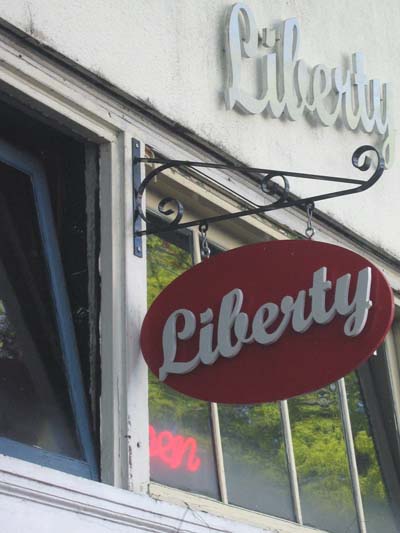
Tags: liberty, liberty bar, libertybar, the name liberty, bars, signs, Seattle

twitter-phonetic.jpg

The name Twitter is not itself a pun, but it’s a set-up for a pun. It pretends to be a simple metaphorical name that casts the textual cacophony of its special kind of web exhibitionism as bird noise. But then there’s the connection to the expression all atwitter, used to describe someone filled with emotional agitation and excitement. That expression makes lines like this one, from Dan Frost’s Twitter story in the SF Chronicle, inevitable:

A simple little technology has the digerati all atwitter.

Frost can’t resist making another pun in his next line:

Make that the Twitterati.

In case you haven’t come across Twitter yet, it’s an application that lets anyone read and contribute to a constant stream of short text messages from people describing what they’re doing at that very moment. You can follow it on your phone, an IM client, or the Twitter website.

The Name Inspector signed up for a Twitter account but has not yet succumbed to its temptations. He works hard not to check his email every five minutes-the last thing he needs is something he can check every five seconds.

Something interesting about the metaphor behind Twitter is that it evokes the concept of twittering from the perspective of birds, not humans. If you’re on Twitter, you’re listening to others twitter and you’re twittering yourself. You are a bird. The Name Inspector imagines that for birds it’s very reassuring to be surrounded by the cheerful chirps of your conspecifics. That seems to be at the heart of this name’s charm.

Never mind that the word twitter sounds inconsequential. That’s beside the point. Or rather, maybe it is the point. Twitter is the antidote to news sites where you can read endless articles about the last terrible thing that happened. It lets you revel in non-news-the minutia of everyday human existence. It also, of course, creates a surprising sense of intimacy among complete strangers (even more than a blog does).

A somewhat unfortunate association evoked by this name is the word twit, which has not quite been reclaimed as a badge of honor the way geek and nerd have. Oddly, there’s a netcast company called TWiT (for This WEEK in TECH) whose founder stopped participating on Twitter because his many fans there assumed his company must be part of or associated with Twitter in some way. Consider the irony: someone whose company is called TWiT worrying about being associated with someone else’s company name.

The sound of the name Twitter is light and quick, and there’s something onomatopoetic about it. The voiceless alveolar stop [t] followed by the liquid [w] comes just short of making a whistling or chirping sound. When you say the name, the smallness and rapidity of the movements you make with your tongue, especially when pronouncing the tiny second syllable, suggest little creatures like birds.

Tags: twitter, the name twitter, birds, exhibitionism, voyeurism

Catherine Holahan at BusinessWeek.com has written a nice, though brief, article about the trouble lexicographers have keeping up with all the new words that are being rapidly created and disseminated on the web (e.g. wiki, google, vlog, mash-up). Lexicographers have not traditionally allowed new words into their dictionaries until those words show evidence of consistent and sustained written use. Now that everyone’s writing on the web, the criteria for inclusion are much harder to define and apply. Though this story is not specifically about names, it discusses word-coining strategies relevant to naming, and mentions some words that have been derived from trademarks. It’s worth a look.

Tags: lexicon, lexicography, dictionaries, web language

Tags: signs, naturalstructures, natural structures, slide, playground, volunteerpark, volunteer park, seattle

Limber Media phonetic

A while ago Allegra Searle-LeBel sent in a story about naming her online media-editing startup:

We had been struggling for about 2 months, trying to find the right name. There was this funny, almost mystical sense that it existed *somewhere*. We just needed to keep slogging through the troughs of lame options and almost good enough ideas. I tried combining different parts of my name with words describing our services or industry (BlissArt, MadriGal, DisinterMedia, FemMediate). Terrible and incessant variations on terrible. Not all of them were so bad; some of them would have been good enough. But I didn’t want to have just an okay name. I wanted one that felt right. That rolled off the tongue. That was easy to spell. That had meaning. Eventually, naming showed up on the list of milestones that had to be accomplished in order to further the work. I wrangled all day, learned more about the domain drop process, bought some domains that were “good enough”. I went to bed glad to have chosen something, but still unsettled. I dreamed of standing in a crowd with names being called out to me. I felt happy! I liked them! In the morning, I checked the domains, I checked Google, I laughed at the simplicity. Limber Media, Inc. Now the fun is coming up with slick soundbites, right…? “LimberMedia.com, For anyone who is overextended.”

Limber Media is a nice, mellifluous name. There’s a poetically symmetrical pattern in the consonants, from alveolar (produced with the tongue behind the top front teeth) to bilabial nasal to bilabial stop and then back to bilabial nasal and then alveolar again. And see how the phonetic representation is so pale? That shows what high sonority this name has. There’s uninterrupted voicing-vibration of the vocal folds-when you say the name, and three of the five consonants are sonorants-they allow an unimpeded flow of air and do not introduce noisy turbulence to the speech signal. These qualities provide sound-symbolic support for the idea of limberness (or suppleness or flexibility or something like that).

How does limberness relate to online media editing? Limberness is of course a property of people, not web applications. But, if you think of the users of the application as limber, the implication is that they’re able to move and bend freely with no constraints imposed by their own bodies. This idea of unimpeded motion can apply metaphorically to any kind of human task, suggesting that it can be accomplished easily. The metaphor works similarly if it applies to a personification of the company or its web app. The idea of limberness also makes a nice connection between the company and its founder, who is a choreographer and dancer as well as a web entrepreneur. Limberness also evokes the more general concept of flexibility, which can apply to objects and materials as well as people. A flexible medium is one that is easily manipulated, so this is a very appropriate association for a media editing service and application.

Allegra’s naming experience illustrates an important point that The Name Inspector has been trying to get across to people lately. The names that are the most descriptive of a company-the ones that are the easiest to come up with-are often not the best ones. Going directly from the idea of the company to the name just doesn’t seem to be that effective. In successful naming efforts, what often happens is that a name idea comes from a dream or a random connection of some kind, and after the name presents itself, so to speak, it just seems to fit. Then, on reflection, one can see what accounts for that fit. This is why naming seems so simple but is actually so hard. Going from the company to the right name is an uphill climb, but getting from the name to the company is-or should be-a ride downhill.

Thanks for your story, Allegra, and good naming work!

Tags: LimberMedia, Limber Media, limber, flexible, editing, online editing, media

Seattleites: Don’t forget to come to the Capitol Hill Arts Center tonight for Ignite Seattle!. The Make Magazine paper airplane event starts at 6:30, and the 5-minute talks start at 8:30 (the second round starts at 9:45). The Name Inspector will be merely one of sixteen fascinating speakers.

Tags: ignite, igniteseattle, ignite seattle, paper airplanes, lightning talks, 5-minute talks

etsy-phonetic.jpg

If you’ve bought an artsy-crafty item on the web lately, or if you read Fred Wilson’s blog A VC, then you’ve probably run into Etsy. Since launching in June 2005, this Brooklyn-based company has managed to build an extremely enthusiastic fan base and become the eBay of handmade goods.

Etsy is all about community. There’s a blog (of course) and a forum and a wiki and something called Etsy Labs, an actual physical space in Brooklyn where they give classes about how to make things. Pretty brilliant-building community and training their own suppliers!

And what about the name Etsy? Where does it come from? Ah, that is the mystery. There’s been a thread about that question for more than a year and a half on the Etsy forum. Etsy developer Rokali/Rob has done nothing to clear the mystery up, and has even cranked up his own fog machine. First he hinted that the name is somehow related to Federico Fellini’s film . In a brief television spot on the company, he suggested that the name is from Latin et si ‘and if’. Another Etsy developer, RevolvingDork, cryptically mentioned the sentence “IT’S A SECRET TO EVERYBODY!” on the forum, and pointed to a screen capture from a video game (which has since been removed). Someone picked up on the clue and conjectured that Etsy is based on that sentence: ignore the article a, make an acronym, reverse the letters, and replace the i with a y. Simple.

Contributors to the forum have also come up with their own theories. One is that Etsy is based on the Unix directory /etc, pronounced “et-C”. The Name Inspector came up with his own crazy theory: if you write eBay as Ebay, the orthographic similarity to Etsy is striking, because the t in Etsy looks like a b missing part of its curve, and the s looks like a backwards a missing a line. Simple. Turns out someone on the forum already thought of that.

Does it really matter where Etsy comes from or what it means? What’s really interesting is the strength of the community’s conviction that Etsy must mean something. People crave meaning, and will look for it if it doesn’t walk up and say “hey”. The desire to figure out the “secret” of the name Etsy might matter more than any true story about its origin.

Of course, whatever the founders may have had in mind when they came up with it, the name Etsy has its own special character. It rhymes with the name Betsy, which makes it vaguely personified and friendly. Mostly it’s tiny. It evokes the phrase itsy-bitsy, and has all the right sound symbolism to match. The -y ending is unmistakeably diminutive sounding. The short and high-ish first vowel and the voiceless alveolar consonants in the middle all add to the smallness evoked by the sound. Also, when you say this name, you make tiny little gestures with the tip of your tongue.

So, why would a company want its name to seem small? Well, it’s cute, and a lot of the stuff sold on Etsy is cute (plush toys that are “shy” and need “lots of hugs”, crocheted anthropomorphic ice cream cones, Big Eye kitty patches, etc.). The cuteness also contributes to the friendly vibe on the website and in the forum.

Cuteness aside, the concept of smallness fits the company. It conveys the idea that the merchandise on the site is made in small quantities on a small scale (usually by individuals rather than companies), and Etsy itself is a small company. Also, smallness suggests precision and attention to minute detail, which is perfect for handmade goods.

The name Etsy projects the image of a small grass-roots start-up. If the company continues to live up to this image, it could be really big.

Tags: Etsy, the name Etsy, handmade, hand-crafted, crafts, artisans, eBay

names-in-the-wild-herfys.jpg

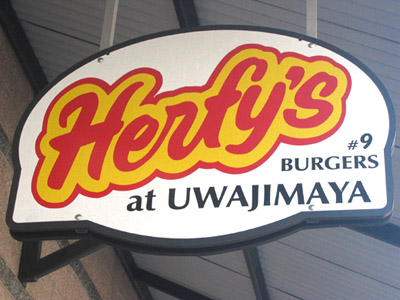
Tags: signs, herfy’s, burgers, restaurant, uwajimaya, seattle

« Prev - Next »