jackson-fish-phonetic.png

Hillel Cooperman of Jackson Fish Market sent a pointer to his naming story, which appears in the first post of his company blog. Head on over and take a look. But please do come back.

Back? Good.

The name Jackson Fish Market belongs to a small software company. That could be outright confusing, couldn’t it? But The Name Inspector guesses it’s really not a problem. Why? It has to do with the contexts in which people first encounter this name. They’re not hearing it on the radio while driving down the interstate. Most likely they’re seeing it as a link on some tech-related web page. In this context they’ll be pretty certain it’s not a name for an actual fish market. They may be curious, as The Name Inspector was when he first encountered it. They may just want to check it out. If they do, chances are that name is going to stick in their minds like, mmm, some kind of sticky fishy thing. It evokes very vivid sensory images.

This is another example of an enigmatic name, one that works largely by playing on people’s curiosity, like the name 37signals. Unlike 37signals, though, it’s not the intrinsic meaning of the name that’s a mystery. We know that Jackson Fish Market “should” refer to a place that sells fish and that’s either on Jackson St. or owned and operated by someone named Jackson. The mystery comes from how this could possibly relate to software development. Is the company located in a building that used to be occupied by a fishmonger? (That was The Name Inspector’s first guess).

Hillel uses this mystery as an opportunity to tell a story about his family history and his attitudes about life and business. Jackson Fish Market was the name of a market owned by his grandfather, Harry Jackson. Hillel wants to associate his software company with a tradition of small family businesses. This is an interesting twist on the classic immigrant success story. In the classic story, the children of artisans and merchants become doctors and lawyers. In Hillel’s story, that shift has already taken place, and he’s looking to recapture something that was sacrificed in the process.

It’s not just personal history that’s relevant to this name. There’s also an interesting social and economic shift at work. Until fairly recently, commerical software has been created almost exclusively by large corporations with marketing departments. The people who work in those departments usually don’t know or care how software is actually made. They simply sell an image that they think will appeal to the general public. It’s usually a bland image focusing on productivity and efficiency.

Behind the marketing facade, though, are people who think of themselves as builders and artisans. They get their hands dirty every day creating the virtual world that we all spend so much time in. For them, software is something real. Small software companies like Jackson Fish Market, which are becoming more common largely because it’s getting much easier and cheaper to start such companies, give the geeks a chance to sell the goods themselves. When they do, they let their own perspective shine through. They present their product as something real. Like slimy fish.

This is a pretty long name, but that goes with the folksy old-fashioned image it presents. It’s nice that it can be shortened to Jackson Fish, though.

Tags: Jackson Fish Market, Jackson Fish, software companies

amazon-phonetic.png

It’s probably safe to say that Amazon (or Amazon.com) has achieved the status of an iconic name.

So, does the word Amazon bear any meaningful relation to the company Amazon.com? Amazon is of course the name of the South American river which is the largest in the world. There were also ancient women warriors, made famous through Greek mythology, that we call Amazons.

It’s unlikely that Amazon.com is intended to be associated with the second meaning. In fact, the company embarrassed itself back in 1999 during a trademark dispute with a feminist bookstore called Amazon Bookstore, which had been using that name since long before the web existed, and sued Amazon.com. According to Salon.com, Amazon.com lawyers questioned one of the bookstore owners in pre-trial depositions about her sexual orientation and the orientations of bookstore employees. Company representatives claimed they were just trying to establish that Amazon Bookstore catered specifically to a lesbian clientele, and that the two companies were therefore in “different businesses” and could both use the name Amazon. Yeah, right.

So it’s the river association they were going after. According to this WIPO arbitration document, about a separate trademark dispute in which Amazon was the complainant,

Mr Bezof [sic] chose the name for the site because the River Amazon in South America is the biggest river in the world and one of the company’s goals was eventually to offer the largest selection of book titles in the world.

A large river serves as a good metaphor for a a huge retail operation like Amazon.com. The comparison implies that Amazon has an endless supply of books (and now other products), just like a river has an endless supply of water. This idea also seems to be played upon by the name Endless.com, which Amazon chose for its new site selling shoes and handbags.

Note that an endless supply can mean either lots of actual physical books (or other items), or lots of titles, as in the indirect Bezos quote above. In the latter case it means endless variety, and is an example of what Chris Anderson calls The Long Tail. Amazon is a prominent case study in his book of that name. In case you’ve somehow managed to avoid discussions of the Long Tail, the idea is that Amazon’s web-based retail model allows them to profitably sell lots and lots of less popular items, items that, on a graph of items listed in descending order of popularity, would be way out on the long tail.

Aside from the image of a long tail/river, the river metaphor also suggests the inevitability of Amazon actually selling things. A river may have an endless supply of water, but so does the ocean (for all intents and purposes). What makes a river special is that the water is always moving in one direction (barring enormous civil engineering projects). When we think of rivers, deep ideas about force dynamics are active in our minds-we imagine the irresistible pull of the water. Such ideas are at work when we talk about the flow of goods (or of ideas). These associations might have been comforting to Amazon’s investors, who were concerned about Amazon moving enough merchandise to become profitable.

The pronunciation and sound of Amazon support the meaning. Because there are no stops and no voiceless sounds, there is continuous vibration of the vocal folds and flow of air when you say the name. The open vowels contribute to this feeling of free movement.

Amazon had to fight to use their name, and sometimes they fought dirty, but the name may have been worth fighting for.

Tags: Amazon, the name Amazon, Amazon Bookstore, books, bookstore, trademark dispute, Endless.com

digg-phonetic.png

A reader suggested doing a profile of this name, and The Name Inspector thought that was a pretty good idea.

The name Digg depends on felicitous ambiguity, of which The Name Inspector is something of a connoisseur. (He even wrote a dissertation about it, though the kind he focused on there was a bit different). What’s felicitous ambiguity? Well, that’s a term that The Name Inspector just made up, but it’s the property of having more than one meaning appropriate for a given situation. Many good names have this property, but Digg, being based on a single word, displays it in its purest form.

One meaning is ‘investigate, look hard’, as in If you want to find out about this, you’re going to have to dig. A related meaning, found in the expression dig up, is ‘discover’, as in Here’s something I dug up on the internet. Both of these evoke a culturally shared metaphor in which pieces of information are thought of as objects, knowing the information is equated with seeing or holding/possessing the objects, and making others aware of information is uncovering or unearthing the objects. Willfully keeping information secret, or at least making it difficult to know, is understood as covering the objects up. Think of burying a story-a turn of phrase alluded to by the little thumbs-down “Bury” button that you can use to vote against a story.

Digg is a great example of the way a name can tap into a metaphor that is conventionalized and entrenched in our language. In this case, the unearthing metaphor provides a vivid image to help us understand the function of this web application, which is to help people discover stories they might not otherwise read.

Aside from the meanings based on the burying/unearthing metaphor, there is of course the groovy 1960s-70s meaning. You dig? This meaning, similar to that of grok, is something like ‘behold and appreciate’, or sometimes just ‘like a lot’. When you vote for a story on Digg, you’re saying that you dig (like) it, and are asking others to dig (behold and appreciate) it. As with the names YouTube and Biznik, there seems to be an ironic evocation of bygone days in this name. The Name Inspector detects a trend here.

Finally, a meaning of dig that is marginally relevant is the one found in the expression to get in a dig at (someone). This is roughly synonymous with gibe, and means something like ‘a jokingly or backhandedly critical comment’. Voting against someone’s story on Digg might be seen as getting in a dig at them. But maybe The Name Inspector is stretching here.

Phonetically the name Digg is a picture of simplicity: a single, one-syllable word with no consonant clusters. Orthographically, too, it’s quite simple-even with the extra g, it’s shorter than most names. Now, about creative misspellings like that: sometimes they’re distinctive, and sometimes they’re just cheesy. Somehow Digg manages to avoid being cheesy. Those two g’s next to each other look kind of cute, and are vaguely evocative of the word egg. Not relevant, but friendly and familiar.

Tags: Digg, the name Digg, YouTube, Biznik, discovery

Phonetic representation of the name Biznik

What follows is a story from Dan McComb, one of the founders of Biznik, a Seattle-based social network for independent business people. Dan’s story is so well told that it’s quoted in its entirety here.

By the way, the Name Inspector gets a real kick out of the name Biznik, but, as a Biznik member who has had some correspondence with Dan, and who spoke on the same stage as Dan in the first Ignite Seattle event, he is not entirely unbiased.

Biznik was originally The Biz Group. A totally unremarkable and non-trademarkable name. But one that made it clear what we were about - business. But our group wasn’t just about business - it was about indie business, business that thinks outside of the box, that isn’t afraid to challenge the status quo; bootstrapping business, progressive, sustainable business. I wanted a name that:

  1. Contained within it an allusion to what the group is all about
  2. Was short and memorable
  3. The domain name was available.
  4. We could trademark
  5. Ideally, would be a made-up name so that it’s easy to track every single reference to it, ever, on the Internet, using Google alerts.

I spent hours doing who-is lookups, and finding every cool name I could think of was already owned by somebody. Somebody, who when asked, wanted on average $6,000 to part with it. No thanks.

Some names we considered: Bizgroove (our lawyer advised it was too much like Groove Networks, which Microsoft purchased), radicalselfpromotion, bizfire, bizgroupies, and a long list of even worse options. After a couple of weeks of fruitless searching, I remembered something I once heard about creativity - “creativity is the art of absurd combinations.” I thought, why don’t I just start randomly tacking arbitrary suffixes onto “biz” and see what happens. I manage a lot of web sites, so that means I manage a lot of passwords. And one thing I’ve done for a long time is tack made-up suffixes onto real words, to get something that isn’t in the dictionary, but is memorable. One of the suffixes I used to use was n!k. As in, passwordn!k. When I thought of tacking that onto biz to create Biznik, I looked it up, and the .com domain was available. I immediately thought, that’s a stupid name - if nobody else wants it, why would I want it? So I skipped over it and kept trying other combinations, without finding anything satisfying. A few days later I came back to Biznik in my head, and ran it by my partner Lara. It occurred to both of us that it might be pretty good - it met all of our naming goals, and more - it contained an allusion to radical (beatniks, sputnik), and business (biz). I tried it out on a couple of my friends and they all liked it immediately, a reaction that hadn’t happened in the previous possible names I’d shared with them. So I went back to the computer, and sure enough, the domain was still available - I purchased it for 8 bucks.

I later found out that -nik is a Yiddish suffix that means “to have an affinity for.” And the final bonus is that members of Biznik can be referred to as “Bizniks.” It’s a multi-purpose name, and as time has passed we realize how lucky we were to get it. In fact, we discovered it by using waybackmachine.com; the domain had been previously owned by someone in London, who had let it lapse literally a few months before we stumbled on it. How cool is that?

Great story. The Name Inspector would like to thank Dan from the bottom of his heart for not naming this business Bizfire. That would have been a real Mizfire.

Biznik is lots of fun and a great name. It’s the holy grail of domain names: one that carries the right meaning in six letters or less. (An aside: This six-letter rule seems to be received wisdom in the world of web names-does anyone know how it got started?). Combining biz with the radical connotations of the suffix -nik is a surprising and funny juxtaposition that gives this name real personality. Of course, -nik is not really radical in a threatening way. It ironically evokes the Cold War era, and its Yiddish origin, its association with beatnik, and its diminutive sound give it a kind of lighthearted friendliness.

Phonetically the name is great, with the repeated vowel sound and the smooth transition between the sounds [z] and [n], which are similarly pronounced. Biznik is nice orthographically, too, with the two strikingly angular letters z and k and the repetition of the letter i.

Nice name, Dan, and thanks for your story.

Tags: biznik, the name biznik, social networking, business networking, networking

37signals-phonetic.png

The striking thing about the name 37signals is that almost no one will have any idea where it comes from or what it means. It’s an enigma, and if you want to get to the bottom of it, you have to do some investigating. Curiosity is rewarded in the company manifesto:

Mankind constantly analyzes radio waves from outer space in the search for extraterrestrial intelligence. Since this analysis started, almost all of the signal sources have been identified. 37 signals, however, remain unexplained.

So the name is a reference to those radio signals that might, just possibly, be from intelligent extraterrestrial life forms.

The enigmatic name is an interesting way to engage potential customers in a conversation. It can drive them to a website to find out more and provide an excuse to tell them a good story. For 37signals this is an effective strategy, because their marketing materials are well written and full of ideas (they have a manifesto, after all), and their blog, Signal vs. Noise, is one of the most consistently interesting company blogs on the web.

Despite its mysterious nature, this name belongs to a recent trend of web names containing numbers. 43 Things, 43 Folders, 30 Boxes, and 9 Rules are some other examples. What accounts for this trend? First, the scarcity of good single-word domain names. Putting a number in front of a word is an easy way to create a short, available variant. Second, techies are a number-lovin’ crowd, and the use of a specific number in a name implies a kind of quasi-scientific precision.

Though the name 37signals is fun and intriguing, it’s a bit hard to square with the philosophy of this company, which is known for its down-to-earth realism and its lean, easy-to-use web applications (Basecamp, Backpack, etc.) and web development framework (Ruby on Rails), all of which the Name Inspector is a great fan of. While 37signals is reasonably short in its written form, it’s very long in its spoken form (six syllables-compare that to the average of 2.25 syllables for the other names that have been analyzed here so far), and there’s not really any way to shorten it. It’s hard to understand why a lean, agile company would opt for such a name. What’s more, the relevance of this completely opaque name to a clean-and-simple design philosophy is a bit puzzling. Finally, setting aside the we-have-a-clue implications of intelligent signals, why does a realistic, down-to-earth company want to be associated with extraterrestrial life?

These are mysteries that may remain unsolved.

Tags: 37signals, the name 37signals, 37 signals, basecamp, backpack, ruby on rails, rails, 43 things, 43 folders, 30 boxes, 9 rules, signal vs. noise

The Name Inspector would like to thank Michael Laine and Brian Dunbar for their gracious responses to his critical comments about the name LiftPort. Brian links to the critique in a good-natured post. In a comment Michael vows to impress the world with results rather than words. That’s really what matters, isn’t it? In the meantime, check out the posters and T-shirts for sale on the LiftPort website. They feature images from 3D models of the space elevator, and appear to be a lot cooler than the name!

Tags: LiftPort, space elevator, swag, schwag, posters, t-shirts

Phonetic representation of the name LiftPort

Some of the Name Inspector’s readers have commented that the posts so far have all been pretty positive. While he has made a conscious decision to play nice until people get to know him, the Name Inspector is not all bunnies and butterflies. Here’s a story about a name that doesn’t work, bravely submitted by Michael J. Laine, President of LiftPort, a company “dedicated to building an Elevator to Space”. “I am quite interested in your opinion,” Michael wrote in his email, “and feel free to blog about it, if you like”. Here’s more from Michael:

For an interesting lesson in how an idea can get away from its founders, the next Google search should be ‘ “space elevator” LiftPort’. Results for our company are about 1:12 to that of the overall project. And that is fine, as it proves that the concept is taking on a life of its own. However, it tells me that we have not done a great job of branding ourselves to the idea. And that is a little frustrating…

… We named the company to be based on the English version of elevator, a “lift”, combined with a “port” of entry or departure. To me, this seems pretty obvious, and I have gotten feedback that it conveys the image we wanted.

Now the idea of an elevator to space is incredibly exciting, but the name LiftPort just doesn’t capture that excitement. When something is so intrinsically interesting, a descriptive name is often the best way to go. The simple phrase Space Elevator is more interesting than LiftPort, but it’s too descriptive to be a strong trademark.

So what’s the problem with LiftPort?

First, what’s exciting about the “Elevator to Space” idea is that it goes to outer space. There’s nothing about space in the name LiftPort. Lift gets at the idea of going up, but it’s a mundane word and does not evoke a vivid image. It makes The Name Inspector’s spouse think of those little things you put in your shoes to appear an inch or two taller. Doesn’t exactly send the imagination soaring beyond geosynchronous orbit, does it?

Then there’s the word port. It’s a perfectly good word to use in this context, evoking airports and shipping ports. But it’s a bit redundant in combination with lift. Like lift, port also suggests moving or carrying, as in transport and teleport (it is, in fact, derived from the Latin word meaning ‘to carry’). This kind of redundancy makes a compound name fall a bit flat, and squanders the opportunity that such names provide to combine words and their meanings in jarring and delightful ways.

Another problem with the combination of lift and port is that it just leads to too much ambiguity. Either word can be interpreted as a noun or a verb. That makes it especially hard to see how the meanings of the two words should be combined. Is this a port that lifts you up? A lift that ports you somewhere? Something that’s a combination of a lift and a port? A little artful ambiguity in a name is good, but too much is confusing.

Phonetically the name is okay, with balanced sonority and a little poetry from the repeated [t] sounds at the ends of both component words. The sequence of consonants in the middle-[ftp]-is a little hard to pronounce, though.

LiftPort isn’t one of those terrible, embarrassing names. The rationale for it makes perfect sense. It just doesn’t convey the excitement of this venture, and it doesn’t leave a strong impression on the mind. A better name would provide a more vivid image of an elevator going into space.

Tags: LiftPort, the name LiftPort, space, space elevator, elevator to space

Phonetic representation of the name PageFlakes

PageFlakes shows how a quirky but vivid metaphor can make for a good name. In this case the name is for a customizable Ajax personal home page similar to Netvibes.

The quirky, one is almost tempted to say flaky, thing about this name is of course the word flakes. Flakes are insubstantial little things and not necessarily so desirable. Think of dandruff, or paint coming off your wall.

But these possible negative associations don’t matter so much, because it’s apparent that the flake metaphor is evoked in this context not for its emotional appeal, but for its cognitive utility. It gives people a tangible way to understand what the service is and does. Each little draggable box on your Ajax start page is like a miniature page-a flake of a page-that can be moved around.

There’s something interesting to notice here. PageFlakes is a vivid name, and that’s good, but it’s vivid in a particular way. There are different ways for a name to be vivid. Sometimes a name introduces sensory associations in all their minute detail to bathe something in a warm emotional glow, the way Apple does. Other times a name provides a sort of cognitive scaffolding to help people understand what something is all about. In that case the most important sensory associations are schematic ones relating to general size, shape, motion, and other properties that allow us to make inferences about how we might physically interact with something.

So it is with PageFlakes. Flakes are tiny, flat, highly mobile, and cling to things. These associations give us a strong sense of what we’ll be doing when we use PageFlakes, and make the name much more interesting than the name of the competing home page service Netvibes, which doesn’t really give us any inferential meat to sink our teeth into.

All this is not to say that PageFlakes is devoid of emotional appeal. It has a fun association with breakfast cereals like Corn Flakes and Frosted Flakes. Think of something convenient and delicious that you sit down in front of first thing in the morning, and you’ll get the picture.

Phonetically, PageFlakes gets a bit of poetry from the assonance (repeated vowel sounds) and the similarity of the [p] and [f] sounds. The transition between consonants in the middle of the name is a little inelegant, but nothing to lose sleep over.

PageFlakes isn’t a perfect name, but it really gets its apt little metaphor stuck in your mind, and it works.

Tags: PageFlakes, the name PageFlakes, Netvibes, flakes, Ajax, start page, home page, personalization

Phonetic representation of the name Lilipip

The Name Inspector has a special interest in names for tech companies, and not just the ones you’ve already heard of. Names for startups also capture his imagination, and entrepreneurs have begun to send in their naming stories. Here’s a story from Ksenia Oustiougova, founder of Lilipip, which produces mobile educational video content for children:

I have read a couple of Seth Godin’s books from Purple Cow to All marketers are liars, and in one of them he talks about naming the companies. So I finally e-mailed asking how to name my company, and he told me: whatever name you choose, it must yield 0 results when typed in Google search. I set off brainstorming, mostly combining letters into shapes visually (I was an architect in the past), and finally after spending hours in Google I arrived at a hybrid misspelling of “little people” (since they are my customers) mixed with lollipop ( I just like the sound of it) plus liliput - little people from my favorite book when I was a kid, Gulliver in the Liliput land or however it is you guys are saying it in English. Anyway, LILIPIP yielded 0 results in Google, and I breezed through the trademark process. But the whole process took me several weeks, so it didn’t come lightly. I was also sort of ashamed to pronounce it out loud for a while, until it stuck. And when people came up to me talking about my company after the MIT Forum presentation last week, they said it without difficulty. What this name will bring in the future, I have yet to see.

The Name Inspector is a great fan of the name Lilipip and of this story, which illustrates some interesting facts about how naming works today:

  1. Findability is one of the most important considerations in selecting a name. Make sure your name will come at the top of search engine results.
  2. It doesn’t matter how you come up with the idea for your name. What really matters is the process of screening and selection, and having enough good ideas to select from.
  3. Thinking of candidate names and selecting the best one takes more time than you think it will.
  4. That’s okay, because a great name won’t necessarily jump out at you. It’s a good idea to sit with your name ideas for a while, because some strengths are not immediately apparent. For example, you can’t make a snap judgment about the memorability of a name-you have to just wait to see which names continue to stand out in your memory.
  5. Great names have multiple appropriate associations, but need not have any overt meaning.
  6. The way a name looks is important (though not as important as its associations or the way it sounds).

Seth Godin covers some of these points in the post that Ksenia mentions. He really emphasizes (1), and also notices a shift in importance “from what the words mean to what the words remind you of”. He seems close to point (5) here, but goes so far as to suggest that the original meaning of the name you select “doesn’t matter at all”, because what’s important are the secondary meanings the name will acquire in association with your company, product, or service. Here the Name Inspector must disagree. While it’s true that most names no longer generically describe what they stand for, the meanings evoked by the linguistic raw material from which a name is constructed matter a lot. Even the name Starbucks, which Godin rightly points out has little if anything to do with coffee, is made of recognizable parts that nevertheless bring good associations to the table.

Now about the name Lilipip. You can tell this is a name created by an architect, because it has a striking orthographic balance created by repeating visual elements. First there are all those vertical lines, long ones alternating with short ones. The long ones extend up in the two l’s in the left half of the name and down in the p’s in the right half, creating a kind of mirror-image effect. Then of course the three vowel letters in this name are all the same-in fact, every other letter in this name is an i.

The strong orthographic shape of the name reflects a strong phonetic profile. The pattern of repeating consonants and vowels is striking and singsongy in a good way. The liquid [l] sounds and the high vowels are light and diminutive sounding, which is very appropriate for a children’s media company. Let’s just come right out and say it: this name is cute!

Tags: Lilipip, Seth Godin

techcrunch-phonetic.png

TechCrunch is about as hardnosed as a name can be, both in sound and in meaning. Has this helped to establish Michael Arrington as a rainmaker of Web 2.0? Who can say?

What makes this name so badass? First, there’s the no-nonsense word tech, which tells you in no uncertain terms what Mr. Arrington will be writing about. Then there are the meanings of crunch. Perhaps the most relevant is the one found in the expressions crunch numbers and crunch data. In that context crunch means something like ’submit to rigourous, impersonal analysis’. That certainly helps to establish Arrington’s credibility as a critic of new web technologies. There’s also the expression crunch time, which implies furious hard work to meet an impending deadline, especially in the tech industry. Crunch also implies physical exertion, as in do crunches, and destruction, as in crunch, crush, smash, squash, etc. It’s all very macho. (Of course, crunch also suggests snack foods, but that’s hardly relevant here, is it?)

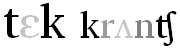
All this crunchiness is supported by the heavy, hard sound of this name. TechCrunch almost seems like it was invented to illustrate the principles of sound symbolism, so important to names, that are represented by the phonetic transcriptions included in these posts. It’s filled with low-sonority sounds (represented by the dark phonetic symbols) and closed syllables (shown by the way the dark symbols serve as “bookends” for each syllable). Then there’s that transition between syllables. The first syllable ends with a [k] sound and the second begins with a [k] sound. In the most natural pronunciation, the first [k] never gets released, so a person saying the name just goes reticent there for a while between syllables. Very brusque.

The name is even heavy orthographically, because there are lots of consonants, and two of them (the final sound of each syllable) are represented by the two letters “ch”. That makes the ratio of letters to syllables pretty high (5:1, in fact).

The name TechCrunch is big and heavy and not so pretty, but it’s serious and it gets the job done.

Tags: TechCrunch, the name TechCrunch, Michael Arrington, Mike Arrington, Arrington, MichaelArrington, MikeArrington

« Prev - Next »